
Saturday, June 27, 2009


Conservative justice policy -- from today's Globe
As the summer progresses, the Prime Minister also will be test-marketing several themes that his party will use against the Liberals in the next election, whenever that occurs.
The first is that the Conservatives are “tough on crime,” whereas the Liberals (and the other parties) are not. As almost every criminologist in Canada would attest, the Conservatives' crime policies are mostly illusory.
The recently proposed legislation allowing victims of terror to sue is a bit of a joke, since finding terrorists in the caves of Pakistan or the jungles of Sri Lanka is hard enough, let alone trying to bring them before Canadian justice. It's one of those “tough on crime” policies that sounds great but means nothing.
Full story here: http://www.theglobeandmail.com/news/opinions/a-summer-of-tory-agitprop/article1199162/
The first is that the Conservatives are “tough on crime,” whereas the Liberals (and the other parties) are not. As almost every criminologist in Canada would attest, the Conservatives' crime policies are mostly illusory.
The recently proposed legislation allowing victims of terror to sue is a bit of a joke, since finding terrorists in the caves of Pakistan or the jungles of Sri Lanka is hard enough, let alone trying to bring them before Canadian justice. It's one of those “tough on crime” policies that sounds great but means nothing.
Full story here: http://www.theglobeandmail.com/news/opinions/a-summer-of-tory-agitprop/article1199162/

End of the curse of Col. Sanders
It's known as the "Curse of Col. Sanders."
Back in 1985, when a baseball team in Osaka, Japan, won a championship, ecstatic fans threw a statue of the founder of Kentucky Fried Chicken into the Dotonbori River in a burst of jubilation. The team hasn't won a championship since.
But on Wednesday, divers found the long-submerged statue, caked with gray sludge, and now fans of the Hanshin Tigers believe the curse may be over.
The fans had picked the Col. Harland Sanders statue because it was the closest thing they could find that looked like Randy Bass, the team's star slugger.
Bass said that usually fans who look like the players they're celebrating jump into the river. But because no one looked like the blond, bearded Bass, they grabbed the statue, dressed it up in Bass' uniform and tossed it.
Bass, who played 130 games over six seasons with five major league clubs including the Hanshin Tigers, is now a state senator for Oklahoma.
"It's incredible," Bass says. "Put all of your money on the Tigers, that's for sure. They definitely have a shot. They have a great team, too."
As a curious aside, Col. Sanders spent the last years of his life in Thornhill, Ontario.
Back in 1985, when a baseball team in Osaka, Japan, won a championship, ecstatic fans threw a statue of the founder of Kentucky Fried Chicken into the Dotonbori River in a burst of jubilation. The team hasn't won a championship since.
But on Wednesday, divers found the long-submerged statue, caked with gray sludge, and now fans of the Hanshin Tigers believe the curse may be over.
The fans had picked the Col. Harland Sanders statue because it was the closest thing they could find that looked like Randy Bass, the team's star slugger.
Bass said that usually fans who look like the players they're celebrating jump into the river. But because no one looked like the blond, bearded Bass, they grabbed the statue, dressed it up in Bass' uniform and tossed it.
Bass, who played 130 games over six seasons with five major league clubs including the Hanshin Tigers, is now a state senator for Oklahoma.
"It's incredible," Bass says. "Put all of your money on the Tigers, that's for sure. They definitely have a shot. They have a great team, too."
As a curious aside, Col. Sanders spent the last years of his life in Thornhill, Ontario.
Ineffective assistance of counsel
Yesterday's decision of the Court in R. v. M.B., 2009 ONCA 524 sets out nicely the test for ineffective assistance of counsel at trial:
(1) Ineffective Assistance of Trial Counsel
[6] An accused who is represented by counsel at trial is entitled to receive effective legal assistance. This entitlement is embodied in the constitutional protections afforded by ss. 7 and 11(d) of the Canadian Charter of Rights and Freedoms. In R. v. Joanisse (1995), 102 C.C.C. (3d) 35, leave to appeal to S.C.C. refused, [1996] S.C.C.A. No. 347, at p. 57, Doherty J.A. of this court explained:
Where counsel fails to provide effective representation, the fairness of the trial, measured both by reference to the reliability of the verdict and the adjudicative fairness of the process used to arrive at the verdict, suffers. In some cases the result will be a miscarriage of justice. This court is under a statutory obligation to quash convictions which are the product of a miscarriage of justice: Criminal Code, s. 686(1)(a)(iii). The accused who is the victim of a miscarriage of justice is entitled to at least a new trial.
[7] The burden of establishing ineffective representation at trial warranting appellate intervention rests on the accused. This burden is not easily discharged. Claims of ineffective representation by trial counsel are approached with caution by appellate courts. As Doherty J.A. observed in Joanisse, at p. 58: "It would be a rare case where, after conviction, some aspect of defence counsel's performance could not be subjected to legitimate criticism. ... Appeals are not intended to be forensic autopsies of counsel's performance at trial."
[8] This court has adopted a three-stage approach to the scrutiny of ineffective representation claims. Under this approach, in order to succeed in a claim of ineffective assistance of counsel at trial, an appellant must establish: (i) the facts on which the claim of incompetence is based; (ii) that the representation provided by trial counsel was incompetent (the performance component of the test); and (iii) that the incompetent representation resulted in a miscarriage of justice (the prejudice component of the test): Joanisse, at p. 59; R. v. P.(T.) (2002), 59 O.R. (3d) 577 ( C.A. ), at para. 19.
[9] In R. v. G.D.B., [2000] 1 S.C.R. 520, at paras. 26-29, Major J. of the Supreme Court of Canada observed that, in most cases, it is best to begin with an inquiry into the prejudice component of an ineffective assistance of counsel claim. If the appellant cannot demonstrate prejudice from the alleged ineffective assistance of counsel, it is unnecessary to address the competence of counsel at trial.
[10] The standard to be met in relation to the performance component of the test is one of reasonableness. Hindsight has no place in this assessment: see R. v. G.D.B., at para. 27; Joanisse, at p. 61. The prejudice component focuses on "the nature and seriousness of counsel's errors both from the perspective of the reliability of the verdict and the adjudicative fairness of the process leading to the verdict": Joanisse, at p. 62. Prejudice can be established if the appellant can show that there is a reasonable probability that but for the alleged incompetence, the result of the proceeding would have been different. A reasonable probability in this context is a probability that is sufficiently strong to undermine the appellate court's confidence in the validity of the verdict: Joanisse, at p. 64; R. v. Dunbar, 2007 ONCA 840, at para. 23. As Doherty J.A. indicated in Joanisse, at p. 64: "A reasonable probability is established when the reviewing court is satisfied that because of counsel's incompetence, the verdict cannot be taken as a reliable assessment of the appellant's culpability."
Friday, June 26, 2009
China cracks down on human rights lawyers
What's most brilliant here (in an evil way) is that no one is stripped of a license -- rather the license just isn't renewed and so there is no "right" taken away... .
Human Rights Lawyers 'Disbarred' by Paperwork
Chinese Officials Decline to Renew Annual Licenses
BEIJING -- In the five years since it was founded, the Yitong Law Firm has established itself as one of the country's fiercest human rights advocates. It represented Hu Jia, the dissident who spoke out against the Tiananmen Square crackdown and on behalf of HIV/AIDS patients; Chen Guangcheng, the blind activist who exposed forced abortions; and hundreds of others its lawyers felt had been wrongly imprisoned.
Its success rate isn't stellar -- it has won at most 60 percent of its cases. But in a country where rule of law is still a work in progress and calling for democracy is often treated as a crime against the state, Yitong and other human rights firms have spoken out for people who otherwise would have been silenced.
Those days may be over.
Since the beginning of 2009 -- a sensitive year filled with anniversaries of uprisings -- the Chinese government has been forcing human rights law firms such as Yitong to shut down.
Formally, there is no crackdown; no police are swooping in to seize files or send attorneys en masse to labor camps. Instead, Beijing is simply using its administrative procedures for licensing lawyers and law firms, declining to renew the annual registrations, which expired May 31, of those it deems troublemakers. Human rights groups say dozens of China's best defense attorneys have effectively been disbarred.
Full story here: http://www.washingtonpost.com/wp-dyn/content/article/2009/06/25/AR2009062503941.html?referrer=emailarticle
Human Rights Lawyers 'Disbarred' by Paperwork
Chinese Officials Decline to Renew Annual Licenses
BEIJING -- In the five years since it was founded, the Yitong Law Firm has established itself as one of the country's fiercest human rights advocates. It represented Hu Jia, the dissident who spoke out against the Tiananmen Square crackdown and on behalf of HIV/AIDS patients; Chen Guangcheng, the blind activist who exposed forced abortions; and hundreds of others its lawyers felt had been wrongly imprisoned.
Its success rate isn't stellar -- it has won at most 60 percent of its cases. But in a country where rule of law is still a work in progress and calling for democracy is often treated as a crime against the state, Yitong and other human rights firms have spoken out for people who otherwise would have been silenced.
Those days may be over.
Since the beginning of 2009 -- a sensitive year filled with anniversaries of uprisings -- the Chinese government has been forcing human rights law firms such as Yitong to shut down.
Formally, there is no crackdown; no police are swooping in to seize files or send attorneys en masse to labor camps. Instead, Beijing is simply using its administrative procedures for licensing lawyers and law firms, declining to renew the annual registrations, which expired May 31, of those it deems troublemakers. Human rights groups say dozens of China's best defense attorneys have effectively been disbarred.
Full story here: http://www.washingtonpost.com/wp-dyn/content/article/2009/06/25/AR2009062503941.html?referrer=emailarticle

Jung's birthday
Today is Carl Jung's birthday.
Carl Gustav Jung was a Swiss psychiatrist, an influential thinker and the founder of analytical psychology known as Jungian psychology.
Jung's approach to psychology has been influential in the field of depth psychology and in countercultural movements across the globe. Jung is considered as the first modern psychologist to state that the human psyche is "by nature religious" and to explore it in depth.
He emphasized understanding the psyche through exploring the worlds of dreams, art, mythology, religion and philosophy.
Although he was a theoretical psychologist and practicing clinician, much of his life's work was spent exploring other areas, including Eastern and Western philosophy, alchemy, astrology, sociology, as well as literature and the arts. His most notable ideas include the concept of psychological archetypes, the collective unconscious and synchronicity.
Carl Gustav Jung was a Swiss psychiatrist, an influential thinker and the founder of analytical psychology known as Jungian psychology.
Jung's approach to psychology has been influential in the field of depth psychology and in countercultural movements across the globe. Jung is considered as the first modern psychologist to state that the human psyche is "by nature religious" and to explore it in depth.
He emphasized understanding the psyche through exploring the worlds of dreams, art, mythology, religion and philosophy.
Although he was a theoretical psychologist and practicing clinician, much of his life's work was spent exploring other areas, including Eastern and Western philosophy, alchemy, astrology, sociology, as well as literature and the arts. His most notable ideas include the concept of psychological archetypes, the collective unconscious and synchronicity.
Mandatory blood transfusion constitutional
A Manitoba law which forced a blood transfusion on a young Jehovah's Witness is constitutional, the Supreme Court ruled today. The case, A.C. v. Manitoba (Director of Child and Family Services), 2009 SCC 30, involved a young Jehovah's Witness, identified only as A.C., who received a court-ordered blood transfusion in 2006. She was 14 when she was admitted to a Winnipeg hospital with internal bleeding. A.C. and her parents refused a transfusion on religious grounds because they believe the Bible forbids ingesting blood.
A case summary follows:
C was admitted to hospital when she was 14 years, 10 months old, suffering from lower gastrointestinal bleeding caused by Crohn's disease. She is a devout Jehovah's Witness and, some months before, had signed an advance medical directive containing her written instructions not to be given blood under any circumstances. Her doctor believed that internal bleeding created an imminent, serious risk to her health and perhaps her life. She refused to consent to the receipt of blood. A brief psychiatric assessment took place at the hospital on the night after her admission. The Director of Child and Family Services apprehended her as a child in need of protection, and sought a treatment order from the court under s. 25(8) of the Manitoba Child and Family Services Act, by which the court may authorize treatment that it considers to be in the child's best interests. Section 25(9) of the Act presumes that the best interests of a child 16 or over will be most effectively promoted by allowing the child's views to be determinative, unless it can be shown that the child does not understand the decision or appreciate its consequences. Where the child is under 16, however, no such presumption exists. The applications judge ordered that C receive blood transfusions, concluding that when a child is under 16, there are no legislated restrictions of authority on the court's ability to order medical treatment in the child's "best interests". C and her parents appealed the order arguing that the legislative scheme was unconstitutional because it unjustifiably infringed C's rights under ss. 2(a), 7 and 15 of the Canadian Charter of Rights and Freedoms. The Court of Appeal upheld the constitutional validity of the impugned provisions and the treatment order.
Held The appeal should be dismissed. Sections 25(8) and 25(9) of the Child and Family Services Act are constitutional.
Per LeBel, Deschamps, Charron and Abella JJ.: When the young person's best interests are interpreted in a way that sufficiently respects his or her capacity for mature, independent judgment in a particular medical decision-making context, the constitutionality of the legislation is preserved. Properly construed to take an adolescent's maturity into account, the statutory scheme strikes a constitutional balance between what the law has consistently seen as an individual's fundamental right to autonomous decision making in connection with his or her body, and the law's equally persistent attempts to protect vulnerable children from harm. The "best interests" standard in s. 25(8) operates as a sliding scale of scrutiny, with the child's views becoming increasingly determinative depending on his or her maturity. The more serious the nature of the decision and the more severe its potential impact on life or health, the greater the degree of scrutiny required. The result of this interpretation of s. 25(8) is that young people under 16 will have the right to demonstrate mature medical decisional capacity. This protects both the integrity of the statute and of the adolescent.
Mature adolescents have strong claims to autonomy, but these claims exist in tension with a protective duty on the part of the state that is justified by the difficulty of defining and identifying "maturity". Any solution to this tension must be responsive to its complexity. Where a child under 16 comes before the court under s. 25 of the Child and Family Services Act, it is the ineffability inherent in the concept of "maturity" that justifies the state's retaining an overarching power to determine whether allowing the child to exercise his or her autonomy in a given situation actually accords with his or her best interests. But "best interests" must in turn be interpreted so as to reflect and respect the adolescent's developing autonomy interest. The more a court is satisfied that a child is capable of making a truly mature and independent decision on his or her own behalf, the greater the weight that must be given to his or her views when a court is exercising its discretion under s. 25(8). If, after a careful analysis of the young person's ability to exercise mature and independent judgment, the court is persuaded that the necessary level of maturity exists, the young person's views ought to be respected.
In assessing an adolescent's maturity in a s. 25(8) "best interests" analysis, a judge should take into account the nature, purpose and utility of the recommended medical treatment and its risks and benefits; the adolescent's intellectual capacity and the degree of sophistication to understand the information relevant to making the decision and to appreciate the potential consequences; the stability of the adolescent's views and whether they are a true reflection of his or her core values and beliefs; the potential impact of the adolescent's lifestyle, family relationships and broader social affiliations on his or her ability to exercise independent judgment; the existence of any emotional or psychiatric vulnerabilities and the impact of the adolescent's illness on his or her decision-making ability. Any relevant information from adults who know the adolescent may also factor into the assessment.
When the "best interests" standard is properly interpreted, the legislative scheme created by ss. 25(8) and 25(9) of the Child and Family Services Act does not infringe ss. 7, 15 or 2(a) of the Charter because it is neither arbitrary, discriminatory, nor violative of religious freedom. Under s. 7 of the Charter, while it may be arbitrary to assume that no one under the age of 16 has capacity to make medical treatment decisions, it is not arbitrary to give them the opportunity to prove that they have sufficient maturity to do so.
With respect to s. 15, in permitting adolescents under 16 to lead evidence of sufficient maturity to determine their medical choices, their ability to make treatment decisions is ultimately calibrated in accordance with maturity, not age, and no disadvantaging prejudice or stereotype based on age can be said to be engaged.
Similarly, since a young person is entitled to lead evidence of sufficient maturity, the impugned provisions do not violate a child's religious convictions under s. 2(a). Consideration of a child's "religious heritage" is one of the statutory factors which a judge must consider in determining the "best interests" of a child under s. 25(8), and expanding the deference to a young person's religious wishes as his or her maturity increases is a proportionate response both to the young person's religious rights and the protective goals of s. 25(8).
Interpreting the best interests standard so that a young person is afforded a degree of bodily autonomy and integrity commensurate with his or her ability to exercise mature, independent judgment navigates the tension between an adolescent's increasing entitlement to autonomy as he or she matures and society's interest in ensuring that young people who are vulnerable are protected from harm. This brings the "best interests" standard in s. 25(8) in line with the evolution of the common law and with international principles, and strikes an appropriate balance between achieving the protective legislative goal while at the same time respecting the right of mature adolescents to participate meaningfully in decisions relating to their medical treatment.
Per McLachlin C.J. and Rothstein J.: The Child and Family Services Act is a complete code for medical decision-making for or by apprehended minors. It requires the judge to be satisfied that a treatment order is in the child's best interests by undertaking an independant analysis of all relevant circumstances and the factors in s. 2(1) of the Act, including the child's needs, mental and emotional maturity and preferences. This multi-factored "best interests of the child" approach required by s. 25(8) does not operate unconstitutionally in the case of a child under 16 who possesses capacity to make a treatment decision and understands the nature and consequences of the treatment.
Section 25(8) of the Child and Family Services Act does not violate s. 7 of the Charter. This provision, although it deprives a child under 16 of the "liberty" to decide her medical treatment and may impinge on her "security of person", does not function in a manner that is contrary to the principles of fundamental justice. The s. 7 liberty or autonomy right is not absolute, even for adults, nor does it trump all other values. Limits on personal autonomy that advance a genuine state interest do not violate s. 7 if they are shown to be based on rational, rather than arbitrary grounds. Here, when the relationship between s. 25(8) and the state interest at stake are considered, the statutory provision is not arbitrary in the substantive sense. The statutory scheme successfully balances society's interest in ensuring that children receive necessary medical care on the one hand, with the protection of their autonomy interest, to the extent this can be done, on the other. The legislative decision to vest treatment authority regarding under-16 minors in the courts is a legitimate response to heightened concerns about younger adolescents' maturity and vulnerability to subtle and overt coercion and influence. This concern with free and informed decision-making animates the legislative scheme and expresses the state's interest in ensuring that the momentous decision to refuse medical treatment by persons under 16 are truly free, informed and voluntary. Age, in this context, is a reasonable proxy for independence. The Act requires the judge to take account of the treatment preference of a minor under 16 as a factor in assessing the child's "best interests", while refusing to give it the presumptive weight it would carry with a child over 16. This distinction reflects the societal reality of how children mature, and the dependence of children under 16 on their parents, as well as the difficulty of carrying out a robust and comprehensive analysis of maturity and voluntariness in the exigent circumstances of crucial treatment decisions in cases such as C's. Further, the s. 7 requirement that the limitation be carried out in a procedurally fair manner is satisfied by the notice and participation requirements in the Child and Family Services Act.
Section 25(8) does not violate s. 15 of the Charter. The distinction drawn by the Act between children under 16 and those 16 and over is ameliorative and not invidious. First, it aims at protecting the interests of minors as a vulnerable group. Second, it protects the targeted group - children under 16 - in a way that gives the individual child a degree of input into the ultimate decision on treatment. This is sufficient to demonstrate that the distinction drawn by the Act, while based on an enumerated ground, is not discriminatory within the meaning of s. 15.
Finally, while the legislative authorization of treatment over C's sincere religious objections constitutes an infringement of her right to religious freedom guaranteed by s. 2(a) of the Charter, the infringement is justifiable under s. 1. The fact that C's aversion to receiving a blood transfusion springs from religious conviction does nothing to alter the essential nature of the claim as one for absolute personal autonomy in medical decision-making. If s. 25(8) is viewed through the lens of s. 2(a), the limit on religious practice imposed by the legislation emerges as justified under s. 1, because the objective of ensuring the health and safety and of preserving the lives of vulnerable young people children is pressing and substantial, and the means chosen - giving discretion to the court to order treatment after a consideration of all relevant circumstances - is a proportionate limit on the right.
The applications judge assumed that C had "capacity" to make the treatment decision but, after considering the relevant factors set out in s. 2(1) of the Child and Family Services Act including her maturity and including her wish not to have the treatment, concluded that treatment was in the child's best interests. This decision conformed to the provisions of the Act. While, if time and circumstances permit, it is optimal for a judge to fully consider and give reasoned judgment on all the factors he or she takes into account, proceeding on the assumption of "capacity" - an assumption that favoured C's autonomy interest - was reasonable in these circumstances where a child's life hung in the balance and the need for a decision was urgent.
Random thoughts on Michael Jackson
People knew of Michael Jackson in every country. He was a great muscian -- whether to your taste or not the man had raw talent -- and his death makes the passing of time even more obvious.
He was only 50 years old, a milestone age. He just celebrated the 25th anniversary of "Thriller," the best-selling album of all time, and re-released it in February.
He was a man with no childhood. And he was always looked down on -- perhaps because of his background. He was often disparaged as a result of his race and his seemingly simple, easy to understand music. That was grossly unfair -- he spoke to millions with subtle melodies and was an icon of the modern (post racial) world.
I remember Time Magazine once published a letter he wrote -- and they printed it as sent, without correcting the spelling or grammar.
I wondered if they would have done that to an establishment figure.
Perhaps, I just know his passing saddens me.
He was only 50 years old, a milestone age. He just celebrated the 25th anniversary of "Thriller," the best-selling album of all time, and re-released it in February.
He was a man with no childhood. And he was always looked down on -- perhaps because of his background. He was often disparaged as a result of his race and his seemingly simple, easy to understand music. That was grossly unfair -- he spoke to millions with subtle melodies and was an icon of the modern (post racial) world.
I remember Time Magazine once published a letter he wrote -- and they printed it as sent, without correcting the spelling or grammar.
I wondered if they would have done that to an establishment figure.
Perhaps, I just know his passing saddens me.
Thursday, June 25, 2009
Majority governments
Regardless of when the next Federal election takes place Canada is not likely to have a majority government. We have to recognize that, with four mainstream political parties represented in Parliament, the chances of one party obtaining a clear majority of seats is slim.
And that has an important implication.
We have to consider ways to have major structural reforms take place while no one party has a majority that can force legislation through.
Look, for example, at the criminal justice system. There is no doubt but that the system needs significant and radical reform, reform that will injure existing stakeholders and be violently opposed as being either anti-civil liberties or being soft on crime.
Such significant reform is, at least in the present climate, impossible to achieve. At most small piecemeal changes – say creating mandatory sentences for some limited number of crimes – are made and even these are contentious.
Timelines are seen in terms of weeks or months at best – but government needs to look to a future years ahead.
So what is to be done?
Dare I suggest durable coalitions???
And that has an important implication.
We have to consider ways to have major structural reforms take place while no one party has a majority that can force legislation through.
Look, for example, at the criminal justice system. There is no doubt but that the system needs significant and radical reform, reform that will injure existing stakeholders and be violently opposed as being either anti-civil liberties or being soft on crime.
Such significant reform is, at least in the present climate, impossible to achieve. At most small piecemeal changes – say creating mandatory sentences for some limited number of crimes – are made and even these are contentious.
Timelines are seen in terms of weeks or months at best – but government needs to look to a future years ahead.
So what is to be done?
Dare I suggest durable coalitions???
Granting leave is sometimes a sign the appeal is seen favourably
Top court to hear sponsorship gag order
OTTAWA-Canada's top court is taking on another press freedom case involving the sponsorship scandal.
The Supreme Court of Canada will hear the Globe and Mail's challenge of a gag order that barred it from reporting settlement talks between Ottawa and a Quebec advertising firm.
Ottawa is suing Groupe Polygone for $35 million, trying to recoup sponsorship money paid by the former Liberal government.
Globe and Mail reporter Daniel Leblanc broke many of the first stories on the scandal with help from unidentified sources.
The top court has already agreed to hear a separate challenge of the Quebec Superior Court's attempt to press Leblanc to reveal his sources.
James Morton
1100-5255 Yonge Street
Toronto, Ontario
M2N 6P4
416 225 2777

Amending civil pleadings
There is a very broad right to amend a civil pleading. Such right shall not be defeated unless the amendment itself causes non-compensable prejudice.
The point is illustrated in today's decision in Iroquois Falls Power Corp. v. Jacobs Canada Inc., 2009 ONCA 517 which provides:
[15] Rule 26.01 of the Rules of Civil Procedure governs amendments to pleadings. It uses mandatory language:
On motion at any stage of an action the court shall grant leave to amend a pleading on such terms as are just, unless prejudice would result that could not be compensated for by costs or an adjournment.
[16] Rule 26.01, therefore, dictates that the court must grant an amendment to a pleading unless the party opposing the amendment shows that:
If the amendment was granted, the party opposing the amendment would suffer non-compensable prejudice, that is, prejudice that could not be compensated for in costs or by an adjournment; and
· The prejudice would result from the amendment.
[17] My quarrel with the motion judge's decision is that he addressed the first element, non-compensable prejudice, but not the second element, whether that prejudice would result from the amendment.
[18] The motion judge identified three items of non-compensable prejudice:
· Two material witnesses for the defendants had died;
· Iroquois Falls changed the turbines at the plant, which made it impossible to determine whether high nitrate oxide levels caused the cracks in the casing of the steam generators; and
· Many relevant documents had been destroyed.
[19] I accept that these three items of prejudice are the sorts of prejudice that may not be compensable by costs or an adjournment. And, in this case, I defer to the motion judge's findings that these items amounted to non-compensable prejudice.
[20] However, to defeat a motion to amend, the party resisting the amendment must show that the non-compensable prejudice it relies on "would result" from the amendment. It must establish a link between the non-compensable prejudice and the amendment. It must show that the prejudice arises from the amendment.
[21] This necessary link is missing in this case. That is because the non-compensable items of prejudice found by the motion judge already existed at or immediately after the time that the original statement of claim was issued. These items of prejudice, therefore, would not result from the amendment.
· Two material witnesses for the defendants had died, but one died in 1998 and the other in 2003;
· Iroquois Falls had changed the turbines, but it did so in the spring of 2003;
· Relevant documents belonging to the defendants were destroyed, but their destruction occurred during Hurricane Katrina in August 2005.
[22] The original statement of claim was issued in June 2005, well within a six-year limitation period. The first two items of prejudice existed well before Iroquois Falls started its action. The third item of prejudice – the destroyed documents – occurred a month before the defendants delivered their statement of defence and thus likely before they began assembling their documents for the lawsuit. These items of prejudice did not arise from the amendment. They existed whether or not Iroquois Falls sought to amend its statement of claim.
...
[29] ... . The defendants did not change their position in reliance on the absence of a claim for breach of contractual warranty. They knew from the outset that whether Iroquois Falls sued for negligent design or breach of warranty, the key question in the litigation was the same: what caused the cracking? The prejudice the defendants relied on was pre-existing prejudice. It was not prejudice that would result from Iroquois Falls' proposed amendment to its statement of claim. I therefore disagree with the motion judge that the defendants incurred the sort of prejudice justifying a refusal to grant the amendment.
James Morton
1100-5255 Yonge Street
Toronto, Ontario
M2N 6P4
416 225 2777
Actress Farrah Fawcett Dies at 62
Not unexpected but sad and reminds us of how time passes ... .
James Morton
1100-5255 Yonge Street
Toronto, Ontario
M2N 6P4
James Morton
1100-5255 Yonge Street
Toronto, Ontario
M2N 6P4
416 225 2777
Contempt must be stricted construed
The contempt power is to be exercised with care and only when the conditions precedent to its use are fully met. Moreover, even should the conditions be met, the judge finding and sentencing for contempt must be express clearly in reasons as to why the power is being used.
The last point was made clear in this week's Court of Appeal decision in International Tour Entertainment Corporation v. Cutting Edge Films Inc., 2009 ONCA 507 where contempt would, on the facts, seem to be made out, but the failure of the judge to express the reasons therefore was fatal:
The last point was made clear in this week's Court of Appeal decision in International Tour Entertainment Corporation v. Cutting Edge Films Inc., 2009 ONCA 507 where contempt would, on the facts, seem to be made out, but the failure of the judge to express the reasons therefore was fatal:
[2] Counsel also submits that the order against the appellant personally is authorized by rule 60.11(6) which provides:
Where a corporation is in contempt, the judge may also make an order under subrule (5) against any officer or director of the corporation and may grant leave to issue a writ of sequestration under rule 60.09 against his or her property.
[3] Although it is clear on the record that the appellant refused to answer questions or to produce documents, the order for contempt against the personal appellant cannot be sustained. The motion judge gave no reasons to explain whether his order was made under rule 60.18(5), concealment in order to defeat or defraud creditors. Nor are there any reasons to explain the jurisdiction of the court to make an order against the personal appellant for contempt, and if the order was made using rule 60.11(6), on what basis that rule can be used in conjunction with rule 60.18(5). Without any reasons to assess, this court is not able to determine on appeal whether, and if so, on what basis there was jurisdiction to make the contempt order.
A Muslim Toronto?
History doesn't repeat itself but it is suggestive.
A Toronto radio show this morning raised concerns that the large Muslim population of Toronto would eventually over run the city.
Let's ignore, for the moment, the point that there isn't anything wrong with a Toronto with a Muslim majority (or Hindu, or Catholic, or anything else; provided minority groups are still free to worship).
My point is to look back a hundred years.
Toronto had a Jewish population that was, depending on whose statistics you accept, as high as 15% of the total population and growing. The Jews of Toronto were, or some of them were, very strange to the earlier residents of the city. They wore odd clothes, ate strange foods, spoke a weird language and were very foreign.
Today the Jewish population of Toronto and surrounding is less than 3% of the population and while there remain religious Jews who do dress and act differently from the mainstream, apart from a few superficial differences (other than faith), mostJews are totally mainstream.
And it is hard to argue (save in an anti-Semitic screed) that Jews over run the City of Toronto. As for the rest of Canada the population is even less prominent.
If in 2110 Toronto is made up of a population of 70% Muslims, living in harmony with other faiths, that's just fine. But I suspect the projections of a Muslim majority Toronto are likely to be as accurate as pre-World War One fears of a Yiddish Scarborough... .
A Toronto radio show this morning raised concerns that the large Muslim population of Toronto would eventually over run the city.
Let's ignore, for the moment, the point that there isn't anything wrong with a Toronto with a Muslim majority (or Hindu, or Catholic, or anything else; provided minority groups are still free to worship).
My point is to look back a hundred years.
Toronto had a Jewish population that was, depending on whose statistics you accept, as high as 15% of the total population and growing. The Jews of Toronto were, or some of them were, very strange to the earlier residents of the city. They wore odd clothes, ate strange foods, spoke a weird language and were very foreign.
Today the Jewish population of Toronto and surrounding is less than 3% of the population and while there remain religious Jews who do dress and act differently from the mainstream, apart from a few superficial differences (other than faith), mostJews are totally mainstream.
And it is hard to argue (save in an anti-Semitic screed) that Jews over run the City of Toronto. As for the rest of Canada the population is even less prominent.
If in 2110 Toronto is made up of a population of 70% Muslims, living in harmony with other faiths, that's just fine. But I suspect the projections of a Muslim majority Toronto are likely to be as accurate as pre-World War One fears of a Yiddish Scarborough... .

Liability of bar for intoxicated customers
From the Sudbury Star:
Board investigating Hanmer bar left by accused
An impaired driving crash on the weekend that took the lives of three teens serves as a harsh reminder for bar owners.
Under the province's Liquor Licence Act, bar staff cannot allow an intoxicated patron to enter the establishment, said Lisa Murray, spokesperson for the Alcohol and Gaming Commission of Ontario.
Neither can bar staff serve a patron to the point of intoxication, she said.
Murray said the commission is conducting an investigation into what happened at Cranky Joe's in Hanmer on Saturday night and early Sunday.
A 26-year-old man was at the establishment that night, bar owner Rob Ferrucci said.
When staff suggested the man shouldn't be driving, Ferrucci said the man told staff he had $70 and a tow truck was going to tow him and his vehicle home.
Nicholas Piovesan has been charged with three counts of impaired driving causing death, three counts of criminal negligence causing death, three counts of failing to remain at the scene of an accident and one count of driving above the legal limit of alcohol in his blood.
The man then allegedly got in his car and drove down Municipal Road 80. Three teens, Steven Philippe, 16, Jazmine Houle, 15, and Caitlin Jelley, 15, were killed after being hit by the driver's vehicle on Municipal Road 80 near Gatien Street.
Bar owners can be charged by police with provincial offences under the Liquor Licence Act.
Bar owners and even hosts of private parties also have a liability under civil law to ensure "whomever you are serving alcohol to is not so intoxicated that they injure themselves or others," said James Morton, a lawyer and former bartender in Toronto.
"As a bartender, you have an enhanced responsibility over, say, a homeowner," Morton said.
If a guest hides the fact they are drinking too much, a homeowner most likely won't be liable. A bartender, however, has an obligation to actually watch for people who are impaired.
"That's part of your duty as a bar owner," Morton said.
The Alcohol and Gaming Commission of Ontario can suspend or revoke a liquor licence if an establishment breaks the rules and regulations set out by the Liquor Licence Act.
"If they failed in their duty to keep an eye out on this customer, then they may be subject to significant civil liability," Morton said.
"The question becomes now not so much legal as factual. What steps did the tavern owner, restaurant owner or staff there take to ensure people were not drinking too much?" he posited.
The courts look at what steps were taken to prevent an intoxicated person from driving.
"The appropriate thing is to say, 'no, you are going to leave the car here tonight and I'll call a taxi,' " Morton said.
- By Rachel Punch, The Sudbury Star
James Morton
1100-5255 Yonge Street
Toronto, Ontario
M2N 6P4
416 225 2777
Wednesday, June 24, 2009
Torontos's Iranian community

It may be that the current regime in Iran will last -- look at Mugabe in Zimbabwe -- but its claim to being a government of the people is long gone. (Canadian Iranians protest on Yonge Street in Toronto).
Objections are necessary to found an appeal
Today's decision in R. v. M.C., 2009 ONCA 509 illustrates the need to object at trial so as to preserve a record for appeal. It appears that Crown counsel said something quite inappropriate; but because no objection was taken the inappropriate comments did not impact the decision below. The Court writes:
4] Third, the appellant raises three comments on reasonable doubt made in closing by the Crown. Crown counsel in this court (who was not counsel at trial) candidly acknowledges that these comments should not have been made. This court has said so forcefully on many prior occasions. Indeed it would be desirable for steps to be taken to ensure that the criminal justice system has seen the last of such comments. However, where, as here, there was no objection and the comments were followed by an excellent charge on reasonable doubt, there is no reversible error.
James Morton
1100-5255 Yonge Street
Toronto, Ontario
M2N 6P4
416 225 2777
4] Third, the appellant raises three comments on reasonable doubt made in closing by the Crown. Crown counsel in this court (who was not counsel at trial) candidly acknowledges that these comments should not have been made. This court has said so forcefully on many prior occasions. Indeed it would be desirable for steps to be taken to ensure that the criminal justice system has seen the last of such comments. However, where, as here, there was no objection and the comments were followed by an excellent charge on reasonable doubt, there is no reversible error.
James Morton
1100-5255 Yonge Street
Toronto, Ontario
M2N 6P4
416 225 2777
Young soldiers
A friend writes:
Three young men, no more than 20 or 21 chuckle as they are frisked at the security pass through - (my heart grows heavy...) - large size 12 combat boots are inspected and given a dusting....(they could be my son)....pockets of nearly new fatigues are rubbed down - I can't take my eyes off them....(good heavens you are but a child...a tear leaks through.....) and the inspector gives them "that look"... A bit of pride.....a bit of thanks....but mostly that look of "God be with you young soldiers...."
A friend shouts past me to the boys...."Good luck in Afghanistan....."
I must to turn away.....and change thoughts...quickly....
Three young men, no more than 20 or 21 chuckle as they are frisked at the security pass through - (my heart grows heavy...) - large size 12 combat boots are inspected and given a dusting....(they could be my son)....pockets of nearly new fatigues are rubbed down - I can't take my eyes off them....(good heavens you are but a child...a tear leaks through.....) and the inspector gives them "that look"... A bit of pride.....a bit of thanks....but mostly that look of "God be with you young soldiers...."
A friend shouts past me to the boys...."Good luck in Afghanistan....."
I must to turn away.....and change thoughts...quickly....

Romeo LeBlanc dies
Romeo LeBlanc, the first Acadian to be appointed governor general of Canada and a central figure in the Liberal party for more than two decades, has died after a lengthy illness.
Defects and irregularities
Generally speaking civil claims are not to be defeated because of a procedural irregularity. That said, where an irregularity is not cured for a lengthy period it may be appropriate for a court to deny relief to repair the defect.
Today's decision in Lo Faso v. Kelton & Ferracuti Consultants Limited, 2009 ONCA 513 holds, as a reason for denying relief:
The failure of the appellants to take any steps to cure the irregularity and to proceed by way of a third party claim for the better part of five years. This inertia was in the face of repeated letters from counsel for the respondent pointing out the obvious defect and inviting the appellants to take the appropriate steps to cure that defect.
James Morton
1100-5255 Yonge Street
Toronto, Ontario
M2N 6P4
416 225 2777
Today's decision in Lo Faso v. Kelton & Ferracuti Consultants Limited, 2009 ONCA 513 holds, as a reason for denying relief:
The failure of the appellants to take any steps to cure the irregularity and to proceed by way of a third party claim for the better part of five years. This inertia was in the face of repeated letters from counsel for the respondent pointing out the obvious defect and inviting the appellants to take the appropriate steps to cure that defect.
James Morton
1100-5255 Yonge Street
Toronto, Ontario
M2N 6P4
416 225 2777

Thoughts on Iran from Lebanon
“...Arab political culture ... remains autocratic and rigid at the top, and passive and frustrated at the grassroots.”
By Rami G. Khouri
The Daily Star, Lebanon
I started writing this column Sunday in Amman, Jordan, and finished writing it Tuesday in Beirut, Lebanon - a short journey that captured how the dynamic events in Iran are playing out in very different ways in a largely passive and vulnerable Arab world.
Jordan and Lebanon contain extremes visible in the Arab world, including pro-American and pro-Iranian sentiments, Islamists, monarchists, and an assortment of tribal, Arab nationalist, state-centered and democratic values.
All of them, without exception, are reacting to events in Iran with fascination, confusion, and concern, reflecting self-inflicted political incoherence and mediocrity that are hallmarks of the modern Arab world.
Rest of the story: http://www.averroespress.com/AverroesPress/Main/Entries/2009/6/24_The_Arabs_watch_Iran_with_forlorn_envy.html
By Rami G. Khouri
The Daily Star, Lebanon
I started writing this column Sunday in Amman, Jordan, and finished writing it Tuesday in Beirut, Lebanon - a short journey that captured how the dynamic events in Iran are playing out in very different ways in a largely passive and vulnerable Arab world.
Jordan and Lebanon contain extremes visible in the Arab world, including pro-American and pro-Iranian sentiments, Islamists, monarchists, and an assortment of tribal, Arab nationalist, state-centered and democratic values.
All of them, without exception, are reacting to events in Iran with fascination, confusion, and concern, reflecting self-inflicted political incoherence and mediocrity that are hallmarks of the modern Arab world.
Rest of the story: http://www.averroespress.com/AverroesPress/Main/Entries/2009/6/24_The_Arabs_watch_Iran_with_forlorn_envy.html
Failure to call witness -- negative inference for Crown
There is a principle, which really is more of a common sense guide, that the failure to call a witness can lead to a negative inference.
Such inference is well established in civil and family cases but is problematic in criminal cases.
The accused has no duty to call evidence and, except in the narrow sense of being required to make an issue live if the burden of going forward lies with the accused, any suggestion the accused failed to 'disprove guilt' is likely a reversible error.
That said, the Crown does have a duty to call evidence and the failure to call a witness relevant and within the Crown's ability to call may lead to a negative inference. See:
R v. Michel et al, 2007 NWTCA 3 (CanLII)
Date: 2007-04-27
Parallel citations: [2007] 404 A.R. 327 • (2007), 221 C.C.C. (3d) 180
URL: http://www.canlii.org/en/nt/ntca/doc/2007/2007nwtca3/2007nwtca3.html
James Morton
1100-5255 Yonge Street
Toronto, Ontario
M2N 6P4
416 225 2777
Such inference is well established in civil and family cases but is problematic in criminal cases.
The accused has no duty to call evidence and, except in the narrow sense of being required to make an issue live if the burden of going forward lies with the accused, any suggestion the accused failed to 'disprove guilt' is likely a reversible error.
That said, the Crown does have a duty to call evidence and the failure to call a witness relevant and within the Crown's ability to call may lead to a negative inference. See:
R v. Michel et al, 2007 NWTCA 3 (CanLII)
Date: 2007-04-27
Parallel citations: [2007] 404 A.R. 327 • (2007), 221 C.C.C. (3d) 180
URL: http://www.canlii.org/en/nt/ntca/doc/2007/2007nwtca3/2007nwtca3.html
James Morton
1100-5255 Yonge Street
Toronto, Ontario
M2N 6P4
416 225 2777
On the off chance you want to let Toronto's mayor know your thoughts...
Mayor David Miller
mayor_miller@toronto.ca
Phone: 416-397-CITY (2489)
Fax: 416-696-3687
Mail:
Toronto City Hall, 2nd Floor,
100 Queen St. West,
Toronto ON
M5H 2N2
mayor_miller@toronto.ca
Phone: 416-397-CITY (2489)
Fax: 416-696-3687
Mail:
Toronto City Hall, 2nd Floor,
100 Queen St. West,
Toronto ON
M5H 2N2
What a great way to make trouble for your boss, your ex or anyone else you don't like but have a licence number for ...
Toronto's snitch line:
"Meantime, people who witness illegal dumping are encouraged to call 416-338-0338 and leave details about where the dumping occurred, including licence plate numbers."
Tuesday, June 23, 2009
Yes, Toronto has a progressive Mayor ... .
David Miller = Stephen Harper?
Well, that's not fair... to Stephen Harper that is ... .
Harper has been pretty consistent on criminal justice -- he's wrong but consistent -- you elect him and you know you're in for greater police surveillance powers and increased penalties for crime.
But Toronto's Mayor Miller? Isn't he a progressive NDP type? Surely his approach will be total different than a big bad Conservative from Alberta ??? (nb, for my less humour minded readers, this is written with a heavy dose of irony).
Well, we've had a city workers strike now for two days and the what is the City's response?
Increased fine for illegal dumping -- up from under $400 to $10,000 and up. Oh yes, and a snitch line. Sort of a lock em up and let the police decide mentality.
What about progressive policies?
I guess it is easier to point the media elsewhere than your own economic failures when you can be "tough on crime".
Hmmn, Miller and Harper seem more and more alike... .
James Morton
1100-5255 Yonge Street
Toronto, Ontario
M2N 6P4
416 225 2777
Well, that's not fair... to Stephen Harper that is ... .
Harper has been pretty consistent on criminal justice -- he's wrong but consistent -- you elect him and you know you're in for greater police surveillance powers and increased penalties for crime.
But Toronto's Mayor Miller? Isn't he a progressive NDP type? Surely his approach will be total different than a big bad Conservative from Alberta ??? (nb, for my less humour minded readers, this is written with a heavy dose of irony).
Well, we've had a city workers strike now for two days and the what is the City's response?
Increased fine for illegal dumping -- up from under $400 to $10,000 and up. Oh yes, and a snitch line. Sort of a lock em up and let the police decide mentality.
What about progressive policies?
I guess it is easier to point the media elsewhere than your own economic failures when you can be "tough on crime".
Hmmn, Miller and Harper seem more and more alike... .
James Morton
1100-5255 Yonge Street
Toronto, Ontario
M2N 6P4
416 225 2777
Burka sign of subservience, not religion, says French president

This is a more difficult issue than at first appears.
Yes, there is a religious freedom issue -- and there is no doubt that the burka and the niqab are religious items -- the same way a kippa and tzitzi are for a Jew.
And there can be little doubt but that if chosen freely, by a competent adult, there is no obvious reason why a burka or niqab should be banned. Free people ought to be allowed to choose -- I am not a fan of tatoos but would never dream of banning them.
But if the burka or niqab is being used to keep women in a state of oppression, and subservient, then perhaps the argument is more complex?
I don't know what I believe -- the burka troubles me, but that may be an unspoken prejudice -- and I am not sure what it is that troubles me about it -- is it oppression of women or is it my unfamiliarity?
Certainly I am not troubled when I see a nun in full habit (and how different is that from a niqab?) -- perhaps I was raised among nuns so do not see them, subconsciously, as a threat ?
Full-body gowns that are worn by the most conservative Muslim women have no place in France, said President Nicolas Sarkozy.
Speaking to a joint session of parliament, the French leader said wearing the burka or the niqab isn't about religion, but the subjugation of women.
"In our country, we cannot accept that women be prisoners behind a screen, cut off from all social life, deprived of all identity," Sarkozy said to extended applause in a speech at the Chateau of Versailles, southwest of Paris.
He said the burka - an all-concealing traditional dress, with built-in mesh covering the eyes - is "a sign of subservience, a sign of debasement."
"I want to say solemnly that it will not be welcome on our territory," he said.
Dozens of French legislators have proposed a parliamentary commission to study the small but growing trend of wearing burkas and niqabs.
In France, the terms "burka" and "niqab" often are used interchangeably. The latter is a full-face veil, often in black. Unlike the burka it does not obscure a woman's eyes.
On Friday, government spokesman Luc Chatel told French television the commission could propose legislation aimed at banning the burka in public if it is found to be degrading for women.
In 2004, a law banning the Islamic headscarf and other highly visible religious symbols from French public schools sparked a heated debate on the issue.
Proponents insisted such a ban was necessary to ensure France's schools remain strictly secular, while some Muslims countered the law specifically targeted them and unduly punished Muslim girls.
No duty to protect
Interesting quotation in today's Globe -- "no duty to protect". Maybe that's the law (I doubt it) but it shouldn't be the policy.
Wasn't the glory of Rome the fact they made sure their citizens were treated properly by foreigners?
Khadr is Canadian -- punish him, perhaps but protect his status as a citizen of Canada and subject of the Crown:
"Justice department lawyer Doreen Mueller spoke on behalf of the Crown today as she urged the Federal Court of Appeal to reject an April ruling calling on the government to request Mr. Khadr's return from the United States.
Ms. Mueller said the Crown rejects the view that it is legally required to protect Canadians under the Charter of Rights when they face charges outside of the country.
"There is clearly no duty to protect citizens under international law," Ms. Mueller told the court"
James Morton
1100-5255 Yonge Street
Toronto, Ontario
M2N 6P4
416 225 2777
Wasn't the glory of Rome the fact they made sure their citizens were treated properly by foreigners?
Khadr is Canadian -- punish him, perhaps but protect his status as a citizen of Canada and subject of the Crown:
"Justice department lawyer Doreen Mueller spoke on behalf of the Crown today as she urged the Federal Court of Appeal to reject an April ruling calling on the government to request Mr. Khadr's return from the United States.
Ms. Mueller said the Crown rejects the view that it is legally required to protect Canadians under the Charter of Rights when they face charges outside of the country.
"There is clearly no duty to protect citizens under international law," Ms. Mueller told the court"
James Morton
1100-5255 Yonge Street
Toronto, Ontario
M2N 6P4
416 225 2777

Toronto snitch line -- a new low for a dysfunctional municipal government
Ah, the City of Toronto has figured out how to deal with the city workers strike -- a snitch line!!!
Yes, the City really is focussed on making life easy for residents. (Forget about helping with, say, emergency dump locations, or maybe even working towards settling the dispute -- give out big fines instead).
Not a serious crime agenda at all
From the Globe and Mail:
With great fanfare, the federal government has recently announced an array of legislation aimed at bolstering its law-and-order credentials. It has succeeded in directing considerable public attention and debate toward everything from the enhancement of victims' rights to the end of conditional sentencing, to an increase in police surveillance powers. Yet the timing of these announcements suggests that attention is what the government is aiming for.
If any of these measures were a legislative priority for the Conservatives, they would have been introduced months ago, with a subsequent attempt to push them through the House of Commons. Parliament sat steadily from January through the end of last week, and was by no means overloaded with legislation. Yet the government waited for the final weeks – in some instances the final days – of the spring session. Given the strong possibility of a fall election, many of these bills may never be debated, much less voted upon.
...
For the Conservatives, this approach has its advantages. They are able to appear to have an active legislative agenda, and can appeal to their support base. At the same time, they can avoid putting their proposed reforms to the constitutional challenges that some of them would face. Nor are they forced to come up with new crime-related legislation to prove they are tough on crime (and perhaps that their opponents are soft on it); instead, they keep the same issues on the table as if in perpetuity.
...
Full story here: http://www.theglobeandmail.com/news/opinions/editorials/eleventh-hour-gestures/article1191498/
With great fanfare, the federal government has recently announced an array of legislation aimed at bolstering its law-and-order credentials. It has succeeded in directing considerable public attention and debate toward everything from the enhancement of victims' rights to the end of conditional sentencing, to an increase in police surveillance powers. Yet the timing of these announcements suggests that attention is what the government is aiming for.
If any of these measures were a legislative priority for the Conservatives, they would have been introduced months ago, with a subsequent attempt to push them through the House of Commons. Parliament sat steadily from January through the end of last week, and was by no means overloaded with legislation. Yet the government waited for the final weeks – in some instances the final days – of the spring session. Given the strong possibility of a fall election, many of these bills may never be debated, much less voted upon.
...
For the Conservatives, this approach has its advantages. They are able to appear to have an active legislative agenda, and can appeal to their support base. At the same time, they can avoid putting their proposed reforms to the constitutional challenges that some of them would face. Nor are they forced to come up with new crime-related legislation to prove they are tough on crime (and perhaps that their opponents are soft on it); instead, they keep the same issues on the table as if in perpetuity.
...
Full story here: http://www.theglobeandmail.com/news/opinions/editorials/eleventh-hour-gestures/article1191498/
Superior Court Jurisdiction
Today's decision in Sorbara v.
[7] We accept the principle put forward by the counsel. A Superior Court has jurisdiction to entertain virtually any claim unless that jurisdiction is specifically, unequivocally and constitutionally removed by Parliament. The motion judge also accepted this principle.
Politics of garbage collection

“There is no Democratic or Republican way of cleaning the streets”
Fiorello La Guardia, Mayor of New York City for three terms from 1934 to 1945.
More electioneering
Let's be clear. The criminal justice system has some major problems.
That's obvious whether you are a conservative Conservative or a liberal Liberal.
What we need is a global overhaul of the entire system. All options on the table. And to do that we need an all Party committee, with genuine experts, a decent budget and a willingness to listen, learn and come up with the best consensus possible.
Ok, not going to happen, but that's what we need.
Random attacks on bits and pieces of the system with scattered legislation addressing isolated issues is just politics. (And I am not opposed to 'truth in sentencing' so long as we have a rational approach to sentencing and treatment).
The story below, which would trouble most readers, is just more politics. The criminal system is too important to reduce to sound bites.
Con on the town
Winnipeg Free Press
Byline: Mike McIntyre mug
Robert Dmytruk shot an innocent bystander to death and tried to kill
the victim's girlfriend so there would be no witnesses.
He's serving time in Stony Mountain and isn't eligible for parole until 2011.
Yet that hasn't stopped the 31-year-old former gang member from exploring Winnipeg shopping malls, visiting the public library,
getting a Slurpee from 7- Eleven or exercising at a city gym in recent months.
Dmytruk didn't make a dramatic prison break nor is he a fugitive on
the run. His forays into the community have been done with the blessing of the National Parole Board and the Correctional Services of Canada .
"It's ridiculous," Manitoba Tory MP Shelly Glover told the Free Press upon learning Dmytruk started getting a taste of freedom almost three full years before his earliest possible release date. "Where is the consideration for the victim's family here?"
Glover said she thought most Canadians would be shocked to hear of Dmytruk's case. She said the federal government plans to act fast to bring new laws that would prevent convicted killers like him from stepping out of prison before they hit their minimum parole eligibility.
"I believe in truth in sentencing. Criminals who commit first- and
second- degree murder should no longer be able to apply for early
release," said Glover. "Our government is working on a number of different clauses."
Timeframes for issuing reasons
R. v. Runnalls, 2009 ONCA 504, released today, sets out guidelines for the reasonable limit for issuing reasons from the Ontario Review Board.
Since the decisions of the Review Board are at least as complex as most Court hearings, Runnalls may be taken as a guide for other judicial officers and their release of reasons.
In this regard, it is likely worth noting that s. 123(5) of the Courts of Justice Act (more or less) requires decisions on motions within three months and trials within six months. This time limit is seldom enforced and this author has waited, on occasion, considerably longer than those time limits for a decision.
The Court in Runnalls writes:
[7] The first issue raised by the Amicus is that the six months taken by the Board to issue its reasons for disposition in this case is unreasonable and has resulted in prejudice to the appellant. The Board issued its disposition on March 14, 2008 in relation to the hearing held on March 10, 2008, but did not deliver its reasons until September 25, 2008.
[8] Particularly because of the Board's statutory mandate to conduct annual review hearings of the status of persons found not criminally responsible and because of an NCR accused's statutory right of appeal, it is essential that the Board be in a position to issue its reasons for disposition in a timely way. This would generally mean much more quickly than within six months of a hearing.
…
[10] That said, I am unable to discern any basis for awarding any form of remedy on the facts of this case. Nothing in the Board's reasons points to the existence of any error or oversight in the formal disposition that was issued. Moreover, there is nothing in the Board's reasons to suggest that they are not a true articulation of its reasoning. Albeit delayed, it is anticipated that the appellant’s next annual review will now be held promptly, in August of this year.
[11] However, like the panel of this court in R. v. Roberts, [2007] O.J. No. 4016, I would urge the Board to take all necessary steps to ensure that reasons are delivered forthwith. In Roberts, this court said:
Although the Board gave its decision in a timely fashion, it did not provide reasons for some six months. It is crucial to the process that the reasons be made available as soon as reasonably possible. We intend no criticism as we are unaware of the circumstances that caused the lengthy delay in the delivery of reasons in the matter. We urge the Board to take all necessary steps to ensure that reasons are delivered forthwith.
[12] Absent exceptional circumstances, I would suggest a range of three to four months as a reasonable outside limit for the release of such reasons. However, for the reasons outlined above, I would not give effect to this ground of appeal in the present circumstances.
Monday, June 22, 2009
Homegrown terrorist?
An agreed statement of facts is not proven.
It is assertions made by the prosecution which are accepted by the convict.
They are sometimes accepted not so much because they are true as because it is better, overall, for the convict not to fight but to take a plea.
Now it's unethical for a lawyer to allow a client to plead guilty where the client says "I didn't do it". But where there are shades of grey a plea is acceptable and then the facts follow.
What really happened here?
Perhaps it was local jihadists. But I sense there's a backstory we haven't heard yet.
Details of a deadly conspiracy emerged in a Brampton court this morning at the sentencing hearing for a Mississauga man who pleaded guilty to a role in a terrorist bomb plot involving the so-called Toronto 18.
According to an agreed statement of facts, Saad Khalid, 22, was part of a bomb plot that was scheduled to go ahead in November 2006.
The alleged mastermind behind the plot, who is one of Khalid's co-accused, planned to target the Toronto Stock Exchange, the Toronto offices of Canada's spy agency and an undisclosed military base, located between Toronto and Ottawa along Highway 401.
The scheme involved filling three U-Haul vans with explosives.
Court heard the attack, which was to be deadlier than the July 2005 London subway bombings, was to be carried out over three days in an effort to instill maximum fear in Canadians.
One of Khalid's co-accused suggested launching the deadly attack on Sept. 11, 2006 — hoping this would prompt Canada to pull its military out of Afghanistan.
...
Khalid was charged with knowingly participating in a terrorist group, receiving training for the purpose of enhancing the ability of a terrorist group and doing anything with "intent to cause an explosion of an explosive substance that was likely to cause serious bodily harm or death."
He pleaded guilty to the last count.
...
Central to the Crown's case against this homegrown terror cell are two alleged conspiracies: that some members attended a terrorist training camp, and that some purchased three tonnes of ammonium nitrate destined for truck bombs.
Court heard that Khalid attended a jihadist training camp in Washago, Ont, in December 2005 and participated in military drills and firearms training. While there, he also listened to speeches exhorting them to wage war on the West. A video of that speech was played in court.
Court also heard that by March 2006, the alleged ringleaders — one of whom was from Scarborough and the other from Mississauga — had a falling-out. After the rift, the Mississauga leader is alleged to have developed a bomb plot.
...
James Morton
1100-5255 Yonge Street
Toronto, Ontario
M2N 6P4
416 225 2777

Stephen Harper on Iran -- the right approach
I'm usually harsh in dealing with Stephen Harper but his position on Iran strikes exactly the right note.
He does not lecture Iran, and does not even hint at meddling, but does express a strong support for democratic values.
"The reaction of the Iranian authorities to the demonstrations in Iran is wholly unacceptable," he said in a statement. "The regime has chosen to use brute force and intimidation in responding to peaceful opposition regarding legitimate and serious allegations of electoral fraud."
"Basic human rights, including freedom of assembly and freedom of expression, are being ignored," Harper said.
"Journalists have been prevented from covering protests and subjected to arbitrary detention and arrest. Foreign press credentials have been revoked," Harper continued.
"Canada calls on the Iranian authorities to immediately cease the use of violence against their own people, to release all political prisoners and journalists - including Canadians - who have been unjustly detained, to allow Iranian and foreign media to report freely on these historic events, and to conduct a full and transparent investigation into allegations of fraud in the presidential election."
"The voices of all Iranians must be heard. I have directed the Minister of Foreign Affairs [Lawrence Cannon] to ensure that Canada's views are conveyed to Iran's top representative in Canada," Harper said.
We can all, Liberal, Conservative, NDP or Bloc be proud of the Federal Government's position.
He does not lecture Iran, and does not even hint at meddling, but does express a strong support for democratic values.
"The reaction of the Iranian authorities to the demonstrations in Iran is wholly unacceptable," he said in a statement. "The regime has chosen to use brute force and intimidation in responding to peaceful opposition regarding legitimate and serious allegations of electoral fraud."
"Basic human rights, including freedom of assembly and freedom of expression, are being ignored," Harper said.
"Journalists have been prevented from covering protests and subjected to arbitrary detention and arrest. Foreign press credentials have been revoked," Harper continued.
"Canada calls on the Iranian authorities to immediately cease the use of violence against their own people, to release all political prisoners and journalists - including Canadians - who have been unjustly detained, to allow Iranian and foreign media to report freely on these historic events, and to conduct a full and transparent investigation into allegations of fraud in the presidential election."
"The voices of all Iranians must be heard. I have directed the Minister of Foreign Affairs [Lawrence Cannon] to ensure that Canada's views are conveyed to Iran's top representative in Canada," Harper said.
We can all, Liberal, Conservative, NDP or Bloc be proud of the Federal Government's position.
Cost of Afghan mission
The Post reports the ongoing cost of the Afghan mission has been withheld from the NDP on the basis of national security. The same numbers were released last year.
Why the change?
Clearly not national security itself.
The Taliban will learn little from a global cost figure.
The best guess is the concern is the growing cost, in large part for soldiers after theatre care, would prove unpopular.
Perhaps the fear is that Afghanistan won't be seen as stimulus spending... .
Truth is, there is a dreadful cost to the mission -- Canadians have a right to know the financial burden as well as the cost in soldiers' lives.
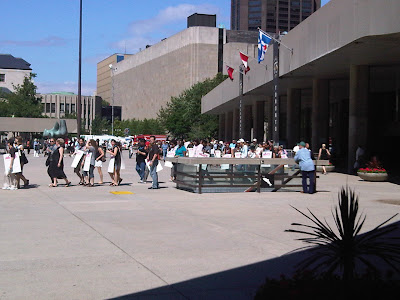
No Gay Pride no Jazz Festival -- Toronto the dull and smelly

At least we'll have dancing rats to entertain us. As of Wednesday we'll have no booze because of a liquor store strike; so drink up mates!
Influence comes from co-operation and compromise
The way to political influence is by participating and co-operating. Confrontation makes from exciting media but usually achieves little.
Absent actual evil (co-operating with, say, Pol Pot would be unthinkable) the best approach is almost always to try to work together.
This is true in Parliament today but more it is true for Canada as a whole. Today's Post has a very perceptive piece, Taking Our Place, a small part of which follows (the link is below the quotation):
It is often said that the Harper government does not have a very strong Quebec team. No doubt, this is probably true, but can you blame the Prime Minister for this? Quebec cannot both go ahead and elect Bloquistes -- a perfectly legitimate choice, of course -- and, at the same time, want to be represented in the federal Cabinet. If Quebecers want to vote for a protest party because they feel that is where the "real power" lies, they are free to do so. But they should not then begin to whine about Quebec having so little influence in the federal political machinery!
In a particularly passionate speech he made to Quebec supporters in June, 2007, then Liberal leader Stephane Dion reminded them of the importance of Quebec participation in federal politics. (Partisanship led him to speak only about the Liberal party, but the reasoning applies across the board.)
"Everything great and influential that has ever happened in the history of Canada has been made possible because Quebecers invested their energy and talents in the Liberal Party of Canada. This was the case under Wilfrid Laurier, just as it was under Mackenzie King. Some great ministers came from Quebec at the time of Mackenzie King, people like Ernest Lapointe and Louis Saint-Laurent; and it was also an amazing period of construction for Canada. And of course Pierre Elliott Trudeau .... Look at each of these periods and you will always find Quebecers who have taken on enormous responsibilities, whether as ministers, members of Parliament, chairs of committees or senior officials. Canada would not be where it is without all of these Quebecers who believed in the Liberal Party of Canada."
http://www.nationalpost.com/m/story.html?id=1719804&s=Today's%20Newspaper
James Morton
1100-5255 Yonge Street
Toronto, Ontario
M2N 6P4
416 225 2777
Good faith and fairness -- is a contractual relationship a condition precedent to such duties arising?
The issue of good faith and fair dealing in contract law is difficult.
There is little doubt that the law has evolved. Cases in the employment context (such as Keays and Wallace) make it clear that in existing relationships there can be a duty of good faith that is not anchored in a specific contractual provision.
The duty to deal with tender bids fairly then poses a question -- until there is a bid there is no relationship in contract -- does this mean there is no duty of fairness?
Last week's Court of Appeal decision in Coco Paving (1990) Inc. v. Ontario (Transportation), 2009 ONCA 503 suggests that a duty of fair dealing can arise only once a strictly compliant tender has been submitted.
This suggests, more broadly, that a duty of good faith is based on an existing relationship arising in contract. Quaere, does this mean that there is no duty of good faith prior to some form of contractual relationship? Could such a duty arise from mere neighbourhood? But if so surely Coco, or a person like Coco, was in the contemplation of Ontario? Perhaps I am seeing too much in this case?
The Court writes:
[4] We begin with this preliminary observation. The analysis of whether Coco's bid was compliant must proceed in recognition of the fundamental tendering law principle that no contractual duties arise between the tender-calling authority and a bidder unless and until what is termed under tendering law as "Contract A" is formed. The formation of Contract A only occurs on the submission of a valid, that is, a compliant bid: see R. v. Ron Engineering & Construction (Eastern) Ltd., [1981] 1 S.C.R. 111, at para. 16; M.J.B. Enterprises Ltd. v. Defence Construction (1951) Ltd., [1999] 1 S.C.R. 619, at paras. 36 and 41. As recently observed by the British Columbia Court of Appeal in Hub Excavating Ltd. v. Orca Estates Ltd., 2009 BCSC 167, at paras. 39 and 40, "[t]here is no free-standing duty of fairness in the bidding process independent of [the] contractual duty [arising on the formation of Contract A.]"
James Morton
1100-5255 Yonge Street
Toronto, Ontario
M2N 6P4
416 225 2777
Services for Justice Panet
The Honourable Mr. Justice A. de Lotbinière Panet, Superior Court of Justice, died of cancer on June 20, 2009 at the age of 69.
Jean-Antoine de Lotbinière Panet (de Lobe) is survived by his loving wife Jane Panet, sisters Suzanne McDougall (Tom McDougall) and Margot Panet (Lewis Lederman), son Philip Panet (Susan Bronskill), daughter Erica Campbell (Robert Campbell) and grandchildren Benjamin and Gabrielle Panet, and MacKenzie and Alexandra Campbell. His sister Mimi Naudie died November 6, 2008. de Lobe was born in Ottawa on May 29, 1940, the second child of Antoine de Lotbiniere and Louise Panet.
He was educated at the University of Ottawa, and Laval University, receiving a B. Comm. in 1959, a Masters of Commerce and Masters of Accounting in 1960, and an LL.B. in 1963. He was made a Chartered Accountant in 1964 and was called to the Ontario Bar in 1965.
In 1971, he and three friends founded the Perley-Robertson, Panet, Hill & McDougall law firm. He was appointed Queen's Council in 1977, and a judge in 1998.
de Lobe loved practicing law, mentoring and teaching young people, and felt privileged to serve as a judge. de Lobe served the community on the boards of the SCO Health Service, the Ottawa Centre for Research and Innovation, the Ontario Arts Council, the Ontario Life Sciences Council, the Commercial and Industrial Development Council of Ottawa-Carleton and the Boys and Girls Club of Ottawa-Carleton and of Canada.
de Lobe lived life with optimism and a spirit of adventure. His great intellect, gentle spirit and passion for life will be greatly missed.
Friends are invited to visit at the Central Chapel of Hulse, Playfair & McGarry, 315 McLeod Street, Ottawa, Ontario, date to be confirmed. A funeral service will be held at Notre Dame Cathedral Basilica, 385 Promenade Sussex, Ottawa on Friday, June 26th at 10:30 a.m.
James Morton
1100-5255 Yonge Street
Toronto, Ontario
M2N 6P4
416 225 2777
Jean-Antoine de Lotbinière Panet (de Lobe) is survived by his loving wife Jane Panet, sisters Suzanne McDougall (Tom McDougall) and Margot Panet (Lewis Lederman), son Philip Panet (Susan Bronskill), daughter Erica Campbell (Robert Campbell) and grandchildren Benjamin and Gabrielle Panet, and MacKenzie and Alexandra Campbell. His sister Mimi Naudie died November 6, 2008. de Lobe was born in Ottawa on May 29, 1940, the second child of Antoine de Lotbiniere and Louise Panet.
He was educated at the University of Ottawa, and Laval University, receiving a B. Comm. in 1959, a Masters of Commerce and Masters of Accounting in 1960, and an LL.B. in 1963. He was made a Chartered Accountant in 1964 and was called to the Ontario Bar in 1965.
In 1971, he and three friends founded the Perley-Robertson, Panet, Hill & McDougall law firm. He was appointed Queen's Council in 1977, and a judge in 1998.
de Lobe loved practicing law, mentoring and teaching young people, and felt privileged to serve as a judge. de Lobe served the community on the boards of the SCO Health Service, the Ottawa Centre for Research and Innovation, the Ontario Arts Council, the Ontario Life Sciences Council, the Commercial and Industrial Development Council of Ottawa-Carleton and the Boys and Girls Club of Ottawa-Carleton and of Canada.
de Lobe lived life with optimism and a spirit of adventure. His great intellect, gentle spirit and passion for life will be greatly missed.
Friends are invited to visit at the Central Chapel of Hulse, Playfair & McGarry, 315 McLeod Street, Ottawa, Ontario, date to be confirmed. A funeral service will be held at Notre Dame Cathedral Basilica, 385 Promenade Sussex, Ottawa on Friday, June 26th at 10:30 a.m.
James Morton
1100-5255 Yonge Street
Toronto, Ontario
M2N 6P4
416 225 2777
Czar Ali Khamenei
Perhaps this is 1905 instead of 1917? The Cossacks are, or will be, marching down the Odessa steps? Or perhaps the analogy is just shot -- whatever, it is very unclear what is happening now.
From the New York Times:
Threatening to crush dissent, the powerful Revolutionary Guards warned protesters Monday that they would face a "revolutionary confrontation" if they returned to the streets in their challenge to the presidential election results and their defiance of the country's leadership.
James Morton
1100-5255 Yonge Street
Toronto, Ontario
M2N 6P4
416 225 2777
The appointments that were announced Friday
Some readers asked for a link to the judicial appointments announced Friday. The link is a bit awkward because you cannot see all the appointments on a single page -- you have to go into several sublinks which makes it less obvious jsut how many appointments were announced on a single day.
To make so many appointments in a single day is quite remarkable. (I have never seen so many at once, not even close, and I have been watching the appointments for years now).
Again, the appointments themselves are good, but my interest is the timing. So many lifetime appointments announced the day the government seemed likely to fall... .
Anyway, here is the link:
http://www.justice.gc.ca/eng/index.html
To make so many appointments in a single day is quite remarkable. (I have never seen so many at once, not even close, and I have been watching the appointments for years now).
Again, the appointments themselves are good, but my interest is the timing. So many lifetime appointments announced the day the government seemed likely to fall... .
Anyway, here is the link:
http://www.justice.gc.ca/eng/index.html
The great Toronto stink off
Well, we have a garbage strike (and park strike and golf course strike etc etc) in Toronto. Already the air near my office is pungent. It's going to be a hot stinky day.
The general reaction is to blame Mayor Miller. And I'd like to join in that chorus -- haven't been a big fan of the Mayor for a while.
He seems to focus on political battle which have little meaning. (In fairness he may have a vision and I miss it; bike paths instead of highways seem foolish in a city like Toronto. Transit City makes more sense -- and I use public transit daily -- so I know how limited the TTC really is).
That said, this strike isn't really the Mayor's fault.
City workers are not, in fact, grossly overpaid. But no administration, in this economy, can possibly grant any significant increases in anything. And that means either a union that backs off or a strike.
The union here has decided to fight. Unless the Mayor, and Council, cave in (which is possible but highly imprudent), the strike will continue until the union blinks.
Now there may be a compromise allowing both sides to save face -- perhaps some 'agreement to review' or a 'joint committee' etc etc.
But for now -- buy some nosegays... .
From today's Globe:
Mayor David Miller said the city is prepared to negotiate at any time but added that the workers have to realize the city isn't in the same financial position that it was last year, and they won't get the same contract as other City of Toronto workers.
"The city is facing enormous budget challenges in 2009 and 2010, and the cost of providing services must in balanced with the revenues the city has to pay the bills," he said at a 1 a.m. press conference, shortly after the union announced the strike. "The world has changed; the city has extremely serious budget challenges. One needs only to look at our welfare rolls to understand that."
James Morton
1100-5255 Yonge Street
Toronto, Ontario
M2N 6P4
416 225 2777
The general reaction is to blame Mayor Miller. And I'd like to join in that chorus -- haven't been a big fan of the Mayor for a while.
He seems to focus on political battle which have little meaning. (In fairness he may have a vision and I miss it; bike paths instead of highways seem foolish in a city like Toronto. Transit City makes more sense -- and I use public transit daily -- so I know how limited the TTC really is).
That said, this strike isn't really the Mayor's fault.
City workers are not, in fact, grossly overpaid. But no administration, in this economy, can possibly grant any significant increases in anything. And that means either a union that backs off or a strike.
The union here has decided to fight. Unless the Mayor, and Council, cave in (which is possible but highly imprudent), the strike will continue until the union blinks.
Now there may be a compromise allowing both sides to save face -- perhaps some 'agreement to review' or a 'joint committee' etc etc.
But for now -- buy some nosegays... .
From today's Globe:
Mayor David Miller said the city is prepared to negotiate at any time but added that the workers have to realize the city isn't in the same financial position that it was last year, and they won't get the same contract as other City of Toronto workers.
"The city is facing enormous budget challenges in 2009 and 2010, and the cost of providing services must in balanced with the revenues the city has to pay the bills," he said at a 1 a.m. press conference, shortly after the union announced the strike. "The world has changed; the city has extremely serious budget challenges. One needs only to look at our welfare rolls to understand that."
James Morton
1100-5255 Yonge Street
Toronto, Ontario
M2N 6P4
416 225 2777

Present state of mind exception to the hearsay rule - a Supreme Court of Canada decision
Hearsay evidence, like any other, must be relevant to be admissible (R. v. Blackman, 2008 SCC 37, [2008] 2 S.C.R. 298, at para. 29). It must tend to "increase or diminish the probability of the existence of a fact in issue" (R. v. Arp, [1998] 3 S.C.R. 339, at para. 38). Under the rule against hearsay, the presumption is that out-of-court statements are inadmissible to prove the truth of their contents (Blackman, at para. 33), absent an exception.
One should first look to the traditional exceptions (R. v. Mapara, 2005 SCC 23, [2005] 1 S.C.R. 358), and then to the principled exception (R. v. Khan, [1990] 2 S.C.R. 531). The traditional exceptions are presumptively valid, though they are still subject to modification in light of the principled analysis of necessity and reliability (R. v. Starr, 2000 SCC 40, [2000] 2 S.C.R. 144).
The admissibility decision is also informed by the judge's residual discretion to exclude evidence where its probative value is outweighed by the potential prejudicial effect (R. v. Hawkins, [1996] 3 S.C.R. 1043, at para. 85; R. v. Smith, [1992] 2 S.C.R. 915, at p.937).
In last week's Supreme Court of Canada decision in R v Griffin 2008 SCJ 28 the Court considered and upheld the present state of mind exception to the hearsay rule where the declarant's state of mind was relevant and the statement was made in a natural manner and not in suspicious circumstances.
The Court writes:
[56] In Smith, Lamer C.J. cited with approval at p. 927, the following excerpt from R. v. P. (R.) (1990), 58 C.C.C. (3d) 334 (Ont. H.C.), per Doherty J. (as he then was), at pp. 343-44:
An utterance indicating that a deceased had a certain intention or design will afford evidence that the deceased acted in accordance with that stated intention or plan where it is reasonable to infer that the deceased did so. ...
The rules of evidence as developed to this point do not exclude evidence of utterances by a deceased which reveal her state of mind, but rather appear to provide specifically for their admission where relevant. The evidence is not, however, admissible to show the state of mind of persons other than the deceased (unless they were aware of the statements), or to show that persons other than the deceased acted in accordance with the deceased's stated intentions, save perhaps cases where the act was a joint one involving the deceased and another person. [Emphasis added.]
[57] Writing for the majority in Starr, Iacobucci J. referred to the above passage in Smith and elaborated on the reasons why a statement of intention cannot be admitted to prove the intentions of someone other than the declarant, stating in part at para. 172:
[T]here are very good reasons behind the rule against allowing statements of present intention to be used to prove the state of mind of someone other than the declarant. As noted above, the central concern with hearsay is the inability of the trier of fact to test the reliability of the declarant's assertion. When the statement is tendered to prove the intentions of a third party, this danger is multiplied. If a declarant makes a statement about the intentions of a third party, there are three possible bases for this statement: first, it could be based on a prior conversation with the accused; second, it could be based on a prior conversation with a fourth party, who indicated the third party's intentions to the declarant; or third, it could be based on pure speculation on the part of the declarant. Under the first scenario, the statement is double hearsay. Since each level of double hearsay must fall within an exception, or be admissible under the principled approach, the mere fact that the declarant is making a statement of present intention is insufficient to render it admissible. The second level of hearsay must also be admissible. [Emphasis in original deleted.]
[58] Applying Smith and Starr to the facts of the present case, there is no doubt that Poirier's statement cannot be admitted as proof of Griffin's intentions, because we do not know the basis on which Poirier came to believe that if he was harmed, Griffin would be responsible. Hence, Poirier's statement is not admissible to prove a third party's intentions, unless the "second level of hearsay" is also admissible. The same principle applies to statements of present state of mind. If, for example, Poirier had said to Williams that his friend Besso was afraid of Griffin, the statement could not be admitted to prove that Besso in fact feared Griffin. That the deceased's hearsay statement about his own state of mind or intention to follow a particular course of action cannot constitute proof of another person's state of mind or intentions only makes good sense.
[59] In the case before us, however, the statement at issue was not admitted to prove the state of mind or intentions of a third party. No one questioned at trial, or in the court below, that the inference that Poirier feared Griffin could be drawn from the former's statement to Williams. The statement was tendered and admitted for the truth of the fact that Poirier himself feared Griffin, a purpose that does not exceed the scope of the "state of mind" exception to the hearsay rule. As this Court stated in Starr, declarations of present state of mind are admissible under the traditional exception to the hearsay rule where the declarant's state of mind is relevant and the statement is made in a natural manner and not under circumstances of suspicion (para. 168). In the present case, there was no argument that the statement was made under circumstances of suspicion. Poirier's fear of Griffin was a relevant fact — it was relevant to motive and, in turn to the issue of identification. Although a declarant's hearsay statement cannot constitute proof of a third party's state of mind, this does not mean that the declarant's state of mind can have no bearing on other issues in the case. I will explain.
[60] As stated earlier, the sole issue at trial was the identity of Poirier's killer. Although Poirier's state of mind may have no direct bearing on the resolution of the identity of his murderer, it is well established that a deceased's mental state may be relevant to the question of an accused's motive. As Doherty J. explained in the oft‑approved judgment in P.(R.), at p. 339:
... the deceased's mental state may bear no direct relevance to the ultimate issue of identification but it will none the less be relevant to that issue if it is relevant to another fact (e.g., motive) which is directly relevant to the ultimate issue of identification.
In turn, that evidence of motive is relevant and admissible particularly where, on the issues of identity and intention, the evidence is purely circumstantial, is equally well established at law: Lewis v. The Queen, [1979] 2 S.C.R. 821, at pp. 834-38.
[61] The state of the relationship between a deceased and an accused in the time period leading up to the former's murder has been recognized as probative of the issue of motive. For example, in R. v. Assoun, 2006 NSCA 47, 244 N.S.R. (2d) 96, identity was the crucial issue at trial. The trial judge admitted statements made by the deceased expressing fear of the accused on the basis that such statements were probative of the issues of "malice, motive, [and] state of mind" (para. 104) which in turn were relevant to identity. The Nova Scotia Court of Appeal agreed (at para. 133):
[The deceased's] state of mind and [the accused's] state of mind are probative of the relationship between them at the time of [the deceased's] murder. Therefore, they are probative of motive, which is relevant to identity.
[62] The conclusion in Assoun echoes that of the Ontario Court of Appeal in R. v. Foreman (2002), 6 C.R. (6th) 201, where the court considered the relationship between a deceased's state of mind and the issue of motive. Upholding the trial judge's admission of statements made by the deceased shortly before her death in which she expressed fear of the accused, the court stated as follows (at para. 30):
Motive refers to an accused's state of mind. ... [T]he deceased's state of mind was one link in a chain of reasoning which could lead to a finding that the [accused] had a motive to kill [the deceased]. In that way, evidence of [the deceased's] state of mind had an indirect connection to the appellant's state of mind.
[63] The connection between a deceased's state of mind and that of an accused arises by virtue of a pre-existing relationship between the two; if a deceased and accused are unknown to one another, this course of logic can find no application. That the relationship between a deceased and an accused was acrimonious or that the two had engaged in a dispute in the period leading up to a murder are highly relevant to the issue of motive because such information may afford evidence of the accused's animus or intention to act against the victim: R. v. Pasqualino, 2008 ONCA 554, 233 C.C.C. (3d) 319, at para. 31. See also R. v. Lemky (1992), 17 B.C.A.C. 71, aff'd [1996] 1 S.C.R. 757. This is not to say that a deceased's state of mind alone is capable of proving motive. Insofar as it affords evidence of the nature of the relationship between a deceased and an accused, however, a deceased's state of mind is one piece of evidence that may be relevant to the issue of motive.
James Morton
1100-5255 Yonge Street
Toronto, Ontario
M2N 6P4
416 225 2777
Sunday, June 21, 2009
Statements must be read in context
Friday's decision in R. v. G.L., 2009 ONCA 501 makes clear the seemingly obvious point that statements by an accused must be considered in their entirety. The Court writes:
[25] She [the trial judge] rejected the appellant's explanations, as it was open to her to do. However, it was not open to her to adopt the suspicious, but inconclusive, remarks by the appellant at one point in the interview as a wholesale inculpatory admission to acts of sexual assault, without assessing the statement as a whole and without at least considering and reconciling the balance of the appellant's statements throughout the interview – some of which, at least, were strikingly exculpatory in nature: R. v. Mallory (2007), 217 C.C.C. (3d) 266 (Ont. C.A.). Respectfully, it is my view that the trial judge failed to assess the statement as a whole.
...
[29] A trial judge is entitled, indeed required, to make findings respecting statements made by an accused and their meaning. But she must do so in context and on the basis of the statement read as a whole. Here, the trial judge focussed almost entirely on the utterances of the appellant that were capable of an inculpatory interpretation and failed to consider or to reconcile the various utterances that were at worst equivocal and – in the one instance, at least – markedly exculpatory in nature. In Mallory, this Court recently referred to the "entire statement" principle in the following terms, at paras. 203 and 208:
In our view, the trial judge erred in approaching the utterances as a series of separate statements rather than as one statement. It is well accepted that if the Crown tenders the statement of an accused, it cannot pick and choose those parts of the statement that it would like the jury to hear; it must take "the good with the bad", and both the "good" and the "bad" are admitted for their truth, for and against the accused. Moreover, a party wishing to adduce a statement must put in as much of the statement as is necessary to permit a fair understanding of the individual utterances.
…
The meaning of an exculpatory utterance proximate to an inculpatory utterance is for the jury to determine in the context of the "whole statement". Giving the jury an isolated utterance taken out of context deprives the jury of the opportunity to decide the true meaning of the whole statement.
[30] The same type of error can occur in a judge alone trial. There is no obligation on a trial judge to mention every syllable of evidence given at a criminal trial in his or her reasons for judgment. However, where the reasons of the trial judge disclose a lack of appreciation of relevant evidence, such as an important portion of an accused person's statement to police, or a disregard of such evidence, a reviewing court will intervene and will conduct a limited reweighing of the evidence in order to ensure that an unreasonable verdict is not sustained: R. v. Biniaris, [2000] 1 S.C.R. 381, at paras. 19-25 and 37.
James Morton
1100-5255 Yonge Street
Toronto, Ontario
M2N 6P4
416 225 2777
Subscribe to:
Posts (Atom)